
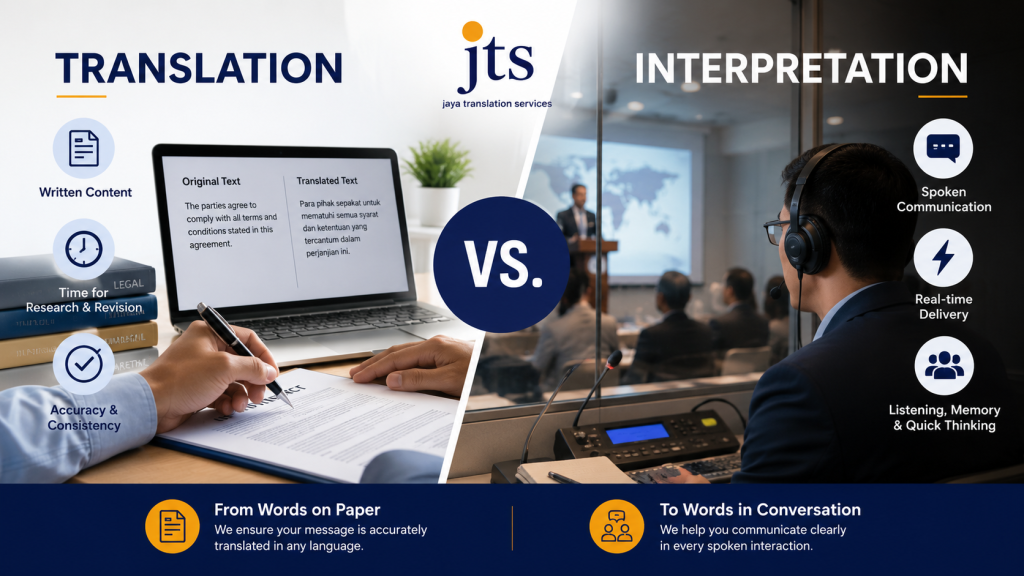
In today’s interconnected world, effective communication across languages is more important than ever. Businesses, government institutions, international organizations, and individuals frequently require language services to engage with multilingual audiences. However, many people use the terms translation and interpretation interchangeably, despite the fact that they refer to two distinct professional services.
Understanding the difference between translation and interpretation can help you choose the right solution for your specific communication needs.
What Is Translation?
Translation is the process of converting written content from one language into another while preserving its meaning, style, tone, and intent.
Professional translators work with written documents such as:
- Contracts and legal agreements
- Technical manuals
- Academic research papers
- Financial reports
- Marketing materials
- Government documents
- Websites and digital content
Unlike interpreters, translators have the advantage of time. They can conduct research, consult reference materials, verify terminology, and carefully revise their work to ensure accuracy and consistency.
Example of Translation
A multinational company expanding into Indonesia may require the translation of:
- Employment contracts
- Product documentation
- Corporate policies
- Marketing brochures
In this case, the translator produces a written document in the target language that can be reviewed, edited, and distributed.
What Is Interpretation?
Interpretation is the process of converting spoken language from one language to another in real time.
Interpreters facilitate communication between people who speak different languages during meetings, conferences, negotiations, training sessions, and other live events.
Unlike translators, interpreters must process information instantly and accurately without the opportunity to revise their output.
Common Types of Interpretation
Simultaneous Interpretation
The interpreter listens to the speaker and delivers the translation almost simultaneously, usually from an interpretation booth using specialized equipment.
This method is commonly used for:
- International conferences
- United Nations meetings
- Government forums
- Large-scale seminars
Consecutive Interpretation
The speaker pauses periodically to allow the interpreter to convey the message in the target language.
This method is often used for:
- Business meetings
- Interviews
- Training sessions
- Diplomatic discussions
Whispered Interpretation
The interpreter quietly interprets directly to one or two participants without the use of equipment.
This approach is suitable for smaller meetings where only a few attendees require language support.
Key Differences Between Translation and Interpretation
| Translation | Interpretation |
|---|---|
| Deals with written content | Deals with spoken communication |
| Produces written documents | Produces spoken communication |
| Allows time for editing and revision | Requires immediate delivery |
| Focuses on writing accuracy and consistency | Focuses on real-time communication |
| Uses reference materials and terminology research | Relies on listening, memory, and speaking skills |
| Examples: contracts, reports, websites | Examples: conferences, meetings, negotiations |
Which Service Do You Need?
The answer depends on your communication objectives.
You Need Translation If:
- You have documents that need to be converted into another language.
- You require legally recognized translations.
- You need multilingual websites or marketing materials.
- You are translating technical, academic, financial, or legal content.
You Need Interpretation If:
- You are hosting an international conference.
- You need multilingual support during meetings.
- You are conducting negotiations with foreign partners.
- You require language assistance during training sessions or workshops.
In some situations, organizations may require both services simultaneously. For example, an international conference may require document translation before the event and interpretation services during the event itself.
Why Professional Language Services Matter
While machine translation tools have improved significantly, they cannot fully replace professional language experts, particularly when accuracy, confidentiality, and cultural sensitivity are critical.
Professional translators and interpreters offer:
- Linguistic accuracy
- Subject matter expertise
- Cultural understanding
- Terminology consistency
- Confidentiality and professionalism
This is particularly important for legal, governmental, technical, medical, and international development projects where misunderstandings can have significant consequences.
Supporting Global Communication
At Jaya Translation Services, we provide both professional translation and interpreting services to government institutions, international organizations, businesses, and individuals.
With more than two decades of experience supporting multilingual communication, our team helps clients bridge language barriers through accurate, reliable, and culturally appropriate language solutions.
Whether you need a translated document or interpreting support for an international event, selecting the right language service is the first step toward successful communication.
Conclusion
Translation and interpretation share the same goal—facilitating communication across languages—but they serve different purposes.
Translation focuses on written content, while interpretation focuses on spoken communication. Understanding this distinction allows organizations and individuals to choose the most effective solution for their needs.
As global communication continues to grow, professional language services remain essential for building understanding, fostering collaboration, and ensuring messages are communicated accurately across cultures and borders.